
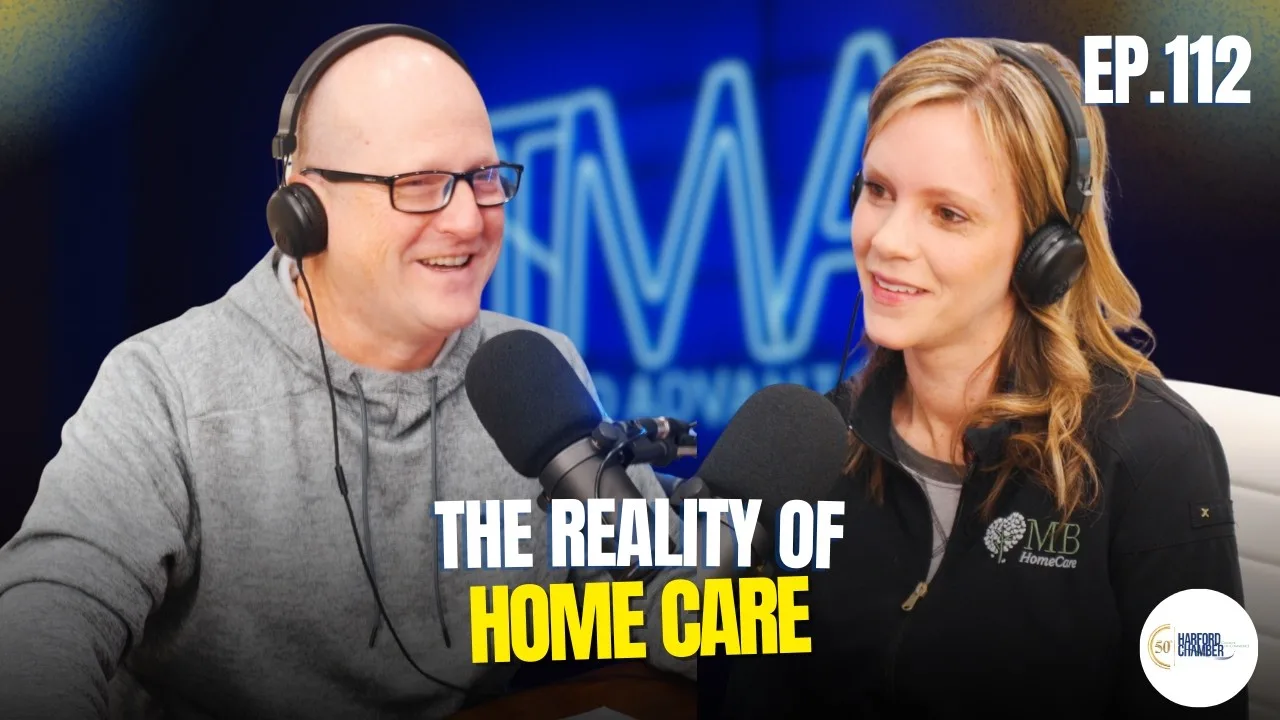

There’s a phone call that changes everything. For Emma Lapp, it came while she was building a career in law enforcement; a job she loved, a path she’d planned on following to the end. The call was about her grandmother and the hard reality of Dementia.
“My family didn’t know how to take care of her,” Emma says plainly. “And neither did I.”
She moved back to Harford County. She navigated the fog of a disease nobody prepares you for. She watched her grandmother stack ladders against the doors at night, convinced someone was breaking in. She was the only person whose food her grandmother would eat, because everyone else was “trying to poison her.” It was, as Emma puts it without drama, “horrific.”
That experience didn’t break her. It redirected her. Today, Emma is the Managing Director of MB HomeCare. A family owned home care agency since 2004, built on the idea that supporting a loved one at home takes a community. She has spent 11 years helping other families navigate the exact terrain that once left her standing lost. And she’s got something most home care executives don’t: she’s been on both sides of the conversation. She’s been the granddaughter on the other end of the phone, scared, overwhelmed, and, as she now admits, deep in what she calls the “river of denial.”
✦ ✦ ✦
The Hardest Part Isn't Caregiving. It's Stopping Being One.
When families first reach out to MB HomeCare, they often come with a version of the same story: they’ve been managing for months. Handling meals, medications, doctor’s appointments. Covering for mom when she forgets. Covering for dad when he can’t quite manage the stove alone anymore. They’ve become, without fully realizing it, full-time caregivers to a parent or grandparent while also trying to be employees, spouses, and parents themselves.
"At some point you just want to be a daughter or a son. You don't want to be the caregiver anymore. You want to visit grandma and sit and drink tea with her — not worry about when the last time she had a shower was."
— Emma Lapp, Managing Director, MB HomeCare
This is the case Emma makes for home care, and it’s not the clinical one. It’s not about medications or mobility or fall prevention, though those things matter enormously. It’s about something softer: preserving the relationship. Giving families back the ability to simply be present with a person they love, instead of spending every visit managing that person’s needs.
“As that person ages and progresses through these diseases, whether it’s dementia, Parkinson’s, or MS, families should have time to build the memories that mean something,” Emma says. “As opposed to building the muscle memory of the care itself.”
See the full conversation come to life—watch the interview.
🔑 CORE IDEA – THE PROMISE
Home care doesn’t just support a senior — it restores the family. When professional caregivers carry the clinical weight, sons and daughters get to be sons and daughters again.
The Mistake Almost Every Family Makes
If Emma had to name the single biggest error she sees families repeat, it’s this: waiting until a crisis forces their hand.
She puts it with the no-nonsense directness of someone who spent years in law enforcement: “You never want to make a decision out of crisis. You don’t even want to buy a car out of crisis… much less hire someone to care for someone you love.”
The signs are usually there well before the emergency. A parent who maybe shouldn’t be driving to the grocery store alone anymore. A dad who wants to go to the racetrack but can’t quite manage it on his own. A mom with a gas stove who loves to cook, but her family has a nagging feeling about leaving her alone in the kitchen.
“That is the time you should start shopping for home care,” Emma says. Not when someone falls. Not when the hospital is calling. Now.
📋 Early Warning Signs — When to Start Shopping
Driving Concerns
Not comfortable with mom driving to the grocery store alone anymore
Activity Limits
Dad wants to go places but can't manage it independently anymore
Kitchen Safety
Parent loves to cook but the stove has become a safety concern
Missed Medications
Inconsistent medication schedules or increasing forgetfulness
Each of these, Emma says, is a signal, not a crisis. Responding to a signal is infinitely better than responding to a 911 call. Her practical advice: pre-screen two or three agencies before you need them. Get to the point where you can say, “I know I can call one of these if the time ever comes.” Knowing who you feel in line with, what their process is, and how they can support in the future lifts a weight families may not even know they are carrying.
🔑 CORE IDEA – THE RULE
Talk to your aging loved ones about what their idea of dignity and aging successfully looks like, before you’re forced to make an assumption about it. Yes, it can be a difficult thing to approach, but choosing the low pressure dicussion now can help you AVOID being forced into a hard conversation later. The car is a great place to start communicating because it’s more casual, and can alleviate the expectation of eye contact or the feeling of sitting down for a serious talk. Chats can be casual, over time.
Not All Home Care Is Created Equal — Here's How to Tell
In Maryland, Emma explains, anyone with $100 and a web browser can register as a home care company. There’s no licensing requirement. No credential check mandated by the state. “So that’s a question you absolutely have to ask when you call: Are you a licensed Residential Service Agency?”
❌ Wrong Questions
- How much does this cost?
- What's the cheapest option?
- How quickly can you start?
✅ Right Questions
- Are you licensed in Maryland?
- Are caregivers certified CNAs?
- How often are background checks run?
- Do you carry driving insurance?
- Is there RN oversight on care plans?
- Do you specialize in dementia or Parkinson's?
For families dealing with a senior who is resistant to having a caregiver in the home – a dynamic Emma calls “everyone, right? Nobody wants help!” MB HomeCare has introduced something genuinely new to the region: an AI-powered virtual monitoring system.
No cameras. No wearables. A HIPAA-compliant, audio-based system that places small “care pods” around the home. The system triggers on care-related events: someone calling out for help, the sound of a fall, signs of respiratory distress. Every alert is reviewed by an RN who determines whether and how to respond.
"It's a nice bridge between 'I don't want help yet' and 'I need some kind of safety net.' And we give it to families at cost."
— Emma Lapp, on MB HomeCare's virtual monitoring program
Emma traveled to Georgia and Tennessee specifically to vet this technology before bringing it north. “My natural personality is: you have to prove to me that it works before I go tell somebody else about it.” The system has been live in homes for over a year and, she predicts, will be standard across the industry within five years. MB is already there.
The Money Conversation Nobody Has Soon Enough
Here’s the part that catches most families off guard: Medicare does not cover home care.
⚕️Home Health vs. Home Care — Know the Difference
- Home Health = goal of getting you BETTER (covered by Medicare). Think PT after a broken leg.
- Home Care = goal of helping you LIVE your best life (NOT covered by Medicare). Ongoing, maintenance support.
- This one distinction explains most of the confusion families have at first call.
The good news: funding options exist that many families overlook. Life insurance policies often contain long-term care provisions that go undiscovered. Pension and retirement packages may include long-term care coverage. And there’s a financial argument for starting early: minimal home care — even once or twice a week — can prevent the hospital admission or rehab stay that costs exponentially more.
⚡ In 60 Seconds — Everything That Matters
- Start looking for home care before you need it. Decisions in crisis are decisions you’ll regret.
- Home care is not created equally. Always ask: Licensed? CNAs? Nurse oversight?
- Medicare covers home health (recovery). It does not cover home care (ongoing living).
- Check old life insurance and pension documents — long-term care coverage may be buried inside.
- Resistant senior? Ask about AI virtual monitoring — affordable, no cameras, nurse-supervised.
- A private case manager or the National Aging in Place Council can give unbiased guidance at no charge.
What Emma Would Tell Her Past Self
The most human moment of the conversation comes when Emma is asked what she would have done differently with her own grandmother’s care. She doesn’t hesitate.
“I probably would have gotten out of the river of denial a little bit sooner.”
The ladders against the doors. The food poisoning delusion. The nights of fear and confusion — not just her grandmother’s, but the whole family’s. “We were saying ‘something’s not right,’ but we didn’t know what it was,” Emma says. “When someone gets a diagnosis like that, you think you’re doing something wrong. But you’re not. You just don’t have the knowledge or the resource to handle it well.”
That knowledge exists now. Those resources exist now. The people willing to share them — openly, without gatekeeping, in the same community where they grew up — they exist too.
You just have to make the call before the crisis does it for you.
✦ ✦ ✦
MB HomeCare was born in Harford County and serves the entire Greater Baltimore Region. Reach Emma directly at 410-440-9535 or emma@mbhomecare.com.
No gatekeeping. No obligation. Just answers from someone who has been there, too.